
President

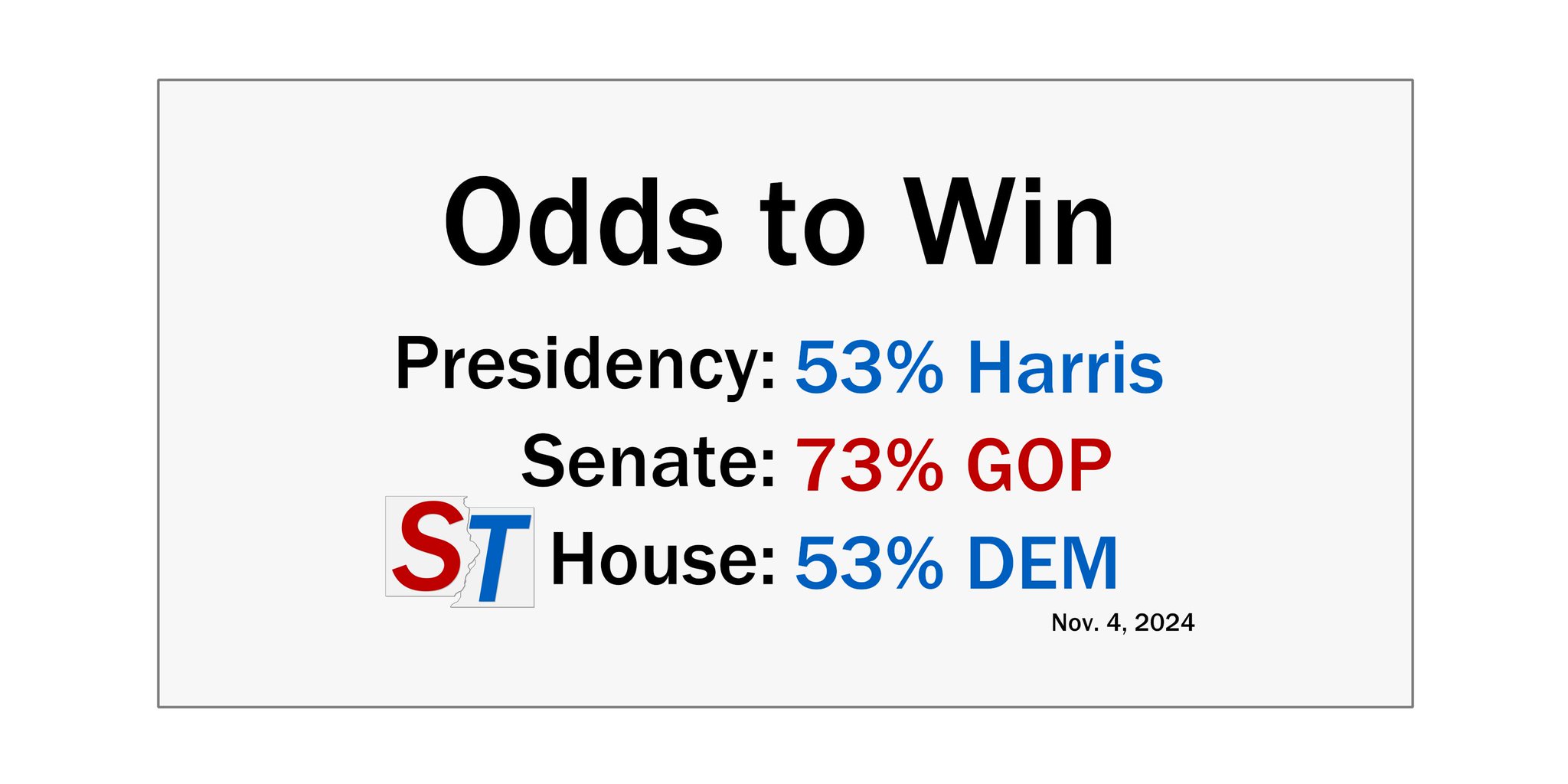
At the presidential level, our model views this race as a tossup, with Kamala Harris as a nominal favorite (making her our pick for the presidency). We give her a 53% chance of winning, and project her to win 270 electoral votes — at the moment, the “Blue Wall” states of Michigan, Wisconsin, and Pennsylvania are the most likely to carry her to victory. However, Nevada, North Carolina, and Georgia are tossups, and it would not surprise us if Harris were to win any or all of these states. (Nevada, in particular, is decided by less than a tenth of a percentage point in our model.)
Trump still has an excellent chance of winning, based on the data available to us. We do want to highlight that a 47% chance is functionally not very different from a 53% one, and models are simply not built to slice down to that level of granularity with too much confidence. When polls show both candidates separated by only half a percent in the tipping point state, the responsible inference to make is that it could go either way.
That’s not to say that it will be close, necessarily — just that it’s uncertain. For example, a minor polling error would see Harris comfortably carry the blue wall and handily win North Carolina, Georgia, Nevada, and even eke out a win in Arizona. Meanwhile, even the tiniest polling error in favor of Donald Trump could hand him the presidency — after all, polls in Pennsylvania currently show him down by only half a percent, and we’ve seen high-profile misses bigger than that in both directions.
We’ve extensively made the case for either Harris or Trump winning the election, based on the data available to us. We would not be surprised by either candidate winning, and perhaps winning handily. But we recognize that many of our readers come here not just for the data, but for our opinions as well. So we’ll give you one now, at the end of the cycle.
If you had to ask us for our read, we would back our model and say that Harris is the slightest of favorites. In the process of writing our piece where we had to make the case for and against each candidate’s victory, we simply found a bit more signal for a Harris victory than we did for a Trump one, and both our model and our polling averages point to a very narrow Harris win.
At the end of the day, Donald Trump has worse favorables than Kamala Harris. Non-polling signals like the Washington Primary continue to point to him and the GOP losing ground in the socially liberal Midwest in the post-Dobbs world, implying a continuation of what we saw in 2022. And recent polls like Ann Selzer’s shocking outlier in Iowa tell a very coherent story and suggest that abortion continues to engender real backlash for the Republicans in socially liberal-to-moderate, pro-choice states, particularly among women and college-educated voters.
We do think there is something to these findings consistently showing up across a variety of mediums over the last two years. It’s also worth noting that election deniers continue to underperform in elections all across the nation, and Donald Trump’s refusal to acknowledge his loss and his insistence on doubling down on his January 6th actions have not helped him one bit.
Trump also trails Harris in relative favorability ratings, with a 7 point deficit in FiveThirtyEight’s averages. We’ve always been skeptical of the DC Beltway “vibe shift”, which followed the betting markets in tilting to Trump strongly over the last three weeks — an analysis of TV media sentiment shows that it’s actually Harris that has enjoyed more favorable sentiment, which can impact how late deciders and independents are likely to view both candidates. And we continue to remain skeptical of the presumptive early vote analysis peddled by many who use it to predict a red wave, as we simply think Democrats are not going to sit out an entire presidential election.
Between the aftermath of inflation, an unpopular President Joe Biden still in office, and the GOP issue edge on the economy and immigration, Trump has a number of winds blowing at his back. We would not be surprised to see a Trump win on election day in the slightest, and we have written a lot about why this might happen.
But between the GOP pivot away from the economy and immigration in favor of anti-transgender ads (which virtually nobody ranks as a top priority), and between a series of undisciplined comments from Trump and the folks in his orbit, he also seems intent on squandering every advantage he has in what remains a very winnable race. He has done himself no favors since Harris replaced Biden atop the ticket, and if he wins, it may well be in spite of the campaign he’s run, rather than because of it.
We still reiterate that this is a tossup, and one in which more pre-election uncertainty exists than perhaps any presidential election in recent memory. In each of the past several elections, it was obvious who the data favored (even if the data ended up being wrong).
This time around, that’s not the case. But to the extent that we can extract any signal from this chaos of noise, we’d probably narrowly rather be Harris, just as our model says.

Senate

From the beginning of this cycle, we’ve noted how difficult this Senate map is for Democrats, especially given that they could only afford to lose one seat. Republicans were guaranteed to flip at least one seat, West Virginia, and there were two more Democrats in red states alone.
Additionally, there are five Democratic-held seats in the seven swing states that Trump could very well carry. Republicans had two potential vulnerabilities of their own, in Florida and Texas, but both states have famously evaded Democratic capture in recent years. All in all, if Republicans had a good year, they might have been poised to gain a half dozen seats, or more.
That year, however, does not appear to have manifested. That is good news for Democrats, but the basic layout of this year’s map means they still remain underdogs to hold the chamber. Republicans will flip West Virginia, and Tim Sheehy has maintained a polling lead over incumbent Democratic Sen. Jon Tester in Montana for months now. If they flipped those two seats alone, and Democrats did not gain any, they would get to 51 seats and take the chamber.
Still, Republicans have another strong offensive opportunity in Ohio, which is the closest Senate race anywhere in the country. Our model has Moreno as the slightest of favorites, with a 56% chance to win, and while the closeness of the race is a statement to the gulf in candidate quality between the two, our model gives the GOP a tiny edge, given that we think Trump wins Ohio by 8 again. A Brown victory would not surprise us at all, but polling shows a dead heat between the two, and the fundamentals slightly favor Moreno.
The best news for Democrats is that Republicans do not appear to have broken through in any of the Democratic-held swing state races. Races in Pennsylvania, Michigan and Wisconsin have tightened, but Democratic candidates in all three cases are still running ahead of Harris, meaning that Trump will probably need to win by more than his 2016 margins in order for Republicans to flip any of these seats. Polls also remain remarkably positive for Senate Democrats in both Arizona and Nevada.
Democrats have made strides in their handful of offensive opportunities. In particular, Colin Allred in Texas is trailing by just under four points in our polling averages, and he does not need Harris to carry Texas to defeat Ted Cruz — he just needs it to be close. Sensing an opening, national Democrats have made a late spending push here.
There are two surprising safe state races that made their way onto the map earlier this year, but have taken divergent paths. In Maryland, popular former Republican Gov. Larry Hogan was wooed into vying for the state’s open Senate seat. Although Hogan initially led most polls, we wrote at the beginning of the year that we had seen this story before. Indeed, Hogan’s numbers have since plummeted; he often trails by double digits. Our model sees this race as Safe Democratic.
The other, Nebraska, did not start out on anyone’s radar. Our August Split Ticket/SurveyUSA poll of Nebraska found incumbent Republican Sen. Deb Fischer leading independent Dan Osborn by just one point. Remarkably, Osborn continues to defy political gravity even as the election closes out, trailing Fischer by just three points in our averages. At the end of the day, this is still an election in Nebraska, so our model sees Fischer as the favorite. But there could be an upset brewing here, especially if Ann Selzer’s Iowa poll is anywhere close to accurate about the political mood in the Great Plains.
Our final forecast gives Republicans a 73% chance to take the Senate, with a 52 Republican, 48 Democratic Senate if we eliminate toss ups. This Republican advantage is built on substantial, but not overwhelming, leads in Montana, Texas, Florida, and Nebraska, all of which are rated Leans Republican. Democratic upsets here are hardly out of the question, but the GOP should be seen as the favorites in all four.
Similarly, on a better than expected night for Trump, the same could be said for Democrats in Michigan, Wisconsin, Pennsylvania, and possibly Arizona and Nevada, which are all rated Leans Democratic. If either of the presidential candidates wins by a substantial amount, the range of possible outcomes becomes much larger.
The final thing we’d like to leave you with here is that while the Republicans are clear favorites based on the data, Democrats have almost the same chances of winning the Senate as Donald Trump did of winning the presidency in 2016. A Democratic victory would be surprising, for sure, but the model does suggest it would not be nearly as surprising as some may think.

House

In 2022, Democrats exceeded expectations. Republicans flipped the House but only won 222 seats — a four-seat majority. Since then, the battle for control of the House has remained contentious. When we released our 2024 House model in June, Republicans had a 56% chance of maintaining control. After Joe Biden dropped out of the race, however, Democratic fortunes improved. Since August, Democrats have been favored to flip the House.
In the final weeks, the generic ballot tightened significantly. Today, Democrats lead by just 0.2% — down from 1.6% one month ago. Our model reflected this narrowing, with the House moving from Leans Democratic to tossup.
Our final forecast gives Democrats a 53% chance of retaking the House. Democrats are currently favored in 214 seats while Republicans have the advantage in 209 seats; 12 seats are tossups. If we pick winners in those tossups, Democrats end up with a razor-thin 219–216 majority, a very close result with only a two-seat margin of error. All this goes to show that, while Democrats are narrow favorites to retake control, the House remains a tossup.
The main reason Democrats remain narrow favorites on the House front, despite the tightening observed in the generic ballot, is fundraising. Currently, Democrats have a clear advantage in terms of funds raised in the key races. Of the 72 districts that are not rated as safe for either party, Democrats have a fundraising advantage in 53 of them. The average difference is nearly $4 million for the Democrats.
Democrats have an advantage of nearly $15 million in CO-03—their largest in any competitive House race nationwide. Democrat Adam Frisch had no problems raising money this cycle after he came within 554 votes of defeating Republican Lauren Boebert in 2022. Democrats also have double-digit edges (or something close to it) in AK-AL, VA-07, and WA-03.
Republicans have a healthy advantage in CA-40, where Young Kim has again proved to be an exceptionally strong candidate. They also have a robust edge in MI-10, where Republican John James is favored to win a rematch against Democrat Carl Marlinga. But outside of that, there isn’t really a clear set of battleground seats in which they can point to a substantial financial edge. This is a critical point we keep noting: when Republicans outspend Democrats, they actually win more often than not. The problem is, in large part, that they simply do not have enough money to do this, especially when it comes to open seats.
Additionally, two seats stand out because both parties are evenly matched in terms of funds raised: NJ-07 and NY-22. Both of these districts are held by vulnerable Republican incumbents and will be crucial to any GOP House majority.
In NJ-07, Democrats have come in big for Sue Altman in the final weeks. Democrats are now at financial parity in the seat, after having been at a cash deficit for quite some time. In NY-22, where our model gives Democrats better chances at winning, Republican Brandon Williams is barely treading water financially. If Democrats end up winning both of these seats, their path to a comfortable House majority would be much clearer.
Let’s conclude by talking about pickups for both sides. We start with the safe seats. In North Carolina, mid-decade redistricting has all but netted the GOP three seats (NC-06, NC-13, NC-14) where Democratic incumbents are retiring. On the flip side, redistricting has also created two majority-Black seats in the deep south. Democrats are strongly favored to pick up AL-02 but even more so LA-06.
Seven Republican incumbents find themselves in seats that are rated Leans or Likely Democratic. The most vulnerable of these is Anthony D’Esposito, who represents NY-04 (a Biden +14.5 district). The seat is currently rated Likely Democratic, with Democrat Laura Gillen expected to notch a comfortable victory on election night. D’Esposito had suffered from a late-breaking scandal on top of the district’s hostile fundamentals.
Republicans Marc Molinaro (NY-19) and Brandon Williams (NY-22) are also underdogs. Democrat Josh Riley has a sizable fundraising advantage of about $4 million in NY-19. While the fundraising is almost nonexistent in NY-22, House Democrats would have won the redrawn seat in 2022.
In NE-02, where Kamala Harris is poised to win comfortably, Republican Don Bacon is facing his toughest reelection yet. We expect Democrat Tony Vargas to be carried over the line. In California, Democrats are favored to unseat John Duarte (CA-13) and Mike Garcia (CA-27) thanks to a combination of fundraising and fundamentals.
The two incumbent Republicans who are favored to lose in tossup races (giving them materially better odds than those in Leans Democratic districts) are Lori Chavez-DeRemer (OR-05) and David Valadao (CA-22). Democrats have a similar fundraising edge in both districts and fundamentals are on their side. That said, Valadao has won his blue district in presidential years before and should not be written off.
Only one Democratic incumbent is at a slight disadvantage (despite a titanic fundraising edge): Marie Gluesenkamp Perez (WA-03). Had Republicans nominated someone more palatable to swing voters than Joe Kent, their chances of flipping this Trump +4.3 district would be better. Finally, Republican Tom Barrett is favored to flip MI-07, an open seat that voted for Biden by just a point in 2020, once held by now-Senate candidate Elissa Slotkin.
Governor

The handful of governor’s races this year have largely been quiet affairs, with the vast majority of elections taking place in safe states. Ironically, the one state that is a true tossup on the presidential level, North Carolina, is also home to a Safe Democratic gubernatorial election. This is thanks to Mark Robinson’s innumerable scandals, leading to his abandonment by the national party. Robinson has trailed by double digits more often than not; on Sunday, NYT/Siena found him down 17 points.
The most interesting race in the country is in New Hampshire, which we have had as a tossup this entire cycle. With the retirement of popular GOP Gov. Chris Sununu, this open seat has become highly competitive. Former Republican Sen. Kelly Ayotte is attempting to mount a comeback, but is being challenged by former Manchester Mayor Joyce Craig. Polling in this race has been tight, but Ayotte has generally been in the lead, despite Harris performing well at the top of the ticket. Craig may need partisanship to save her, but it is possible she has run out of time. We would love to continue calling this a tossup, but if we had to pick, we would go with Tilt Republican here.
Finally, a note on Indiana, which remains Likely Republican in our ratings. Democrats have sent money to the Hoosier State despite its deep red lean. Donald Rainwater, a Libertarian candidate, appears to be drawing votes away from Mike Braun, the Republican, complicating his otherwise straightforward path to the governorship. At the end of the day, partisanship should carry Braun over the top, but do keep an eye out for this race early on Tuesday evening.

I’m a computer scientist who has an interest in machine learning, politics, and electoral data. I’m a cofounder and partner at Split Ticket and make many kinds of election models. I graduated from UC Berkeley and work as a software & AI engineer. You can contact me at lakshya@splitticket.org

I am an analyst specializing in elections and demography, as well as a student studying political science, sociology, and data science at Vanderbilt University. I use election data to make maps and graphics. In my spare time, you can usually find me somewhere on the Chesapeake Bay. You can find me at @maxtmcc on Twitter.

My name is Harrison Lavelle and I am a co-founder and partner at Split Ticket. I write about a variety of electoral topics and handle our Datawrapper visuals.
Contact me at @HWLavelleMaps or harrison@splitticket.org

I make election maps! If you’re reading a Split Ticket article, then odds are you’ve seen one of them. I’m an engineering student at UCLA and electoral politics are a great way for me to exercise creativity away from schoolwork. I also run and love the outdoors!
You can contact me @politicsmaps on Twitter.

I’m a political analyst here at Split Ticket, where I handle the coverage of our Senate races. I graduated from Yale in 2021 with a degree in Statistics and Data Science. I’m interested in finance, education, and electoral data – and make plenty of models and maps in my free time.