
When we introduced our House model in June, Republicans and Democrats were favored in 211 seats each with 13 districts counted as tossups. At the time, Republicans had a 56% chance of retaining the House majority. Since then, the picture has changed substantially, especially after Joe Biden’s withdrawal from the race and replacement by Kamala Harris.
The downballot result of the stark Democratic polling improvement over the last few weeks is a significant spike in the party’s odds of controlling the House of Representatives. Our initial forecast suggested that the race for the chamber was a Republican-tilting tossup; now, however, Democrats hold a small, but clear advantage.
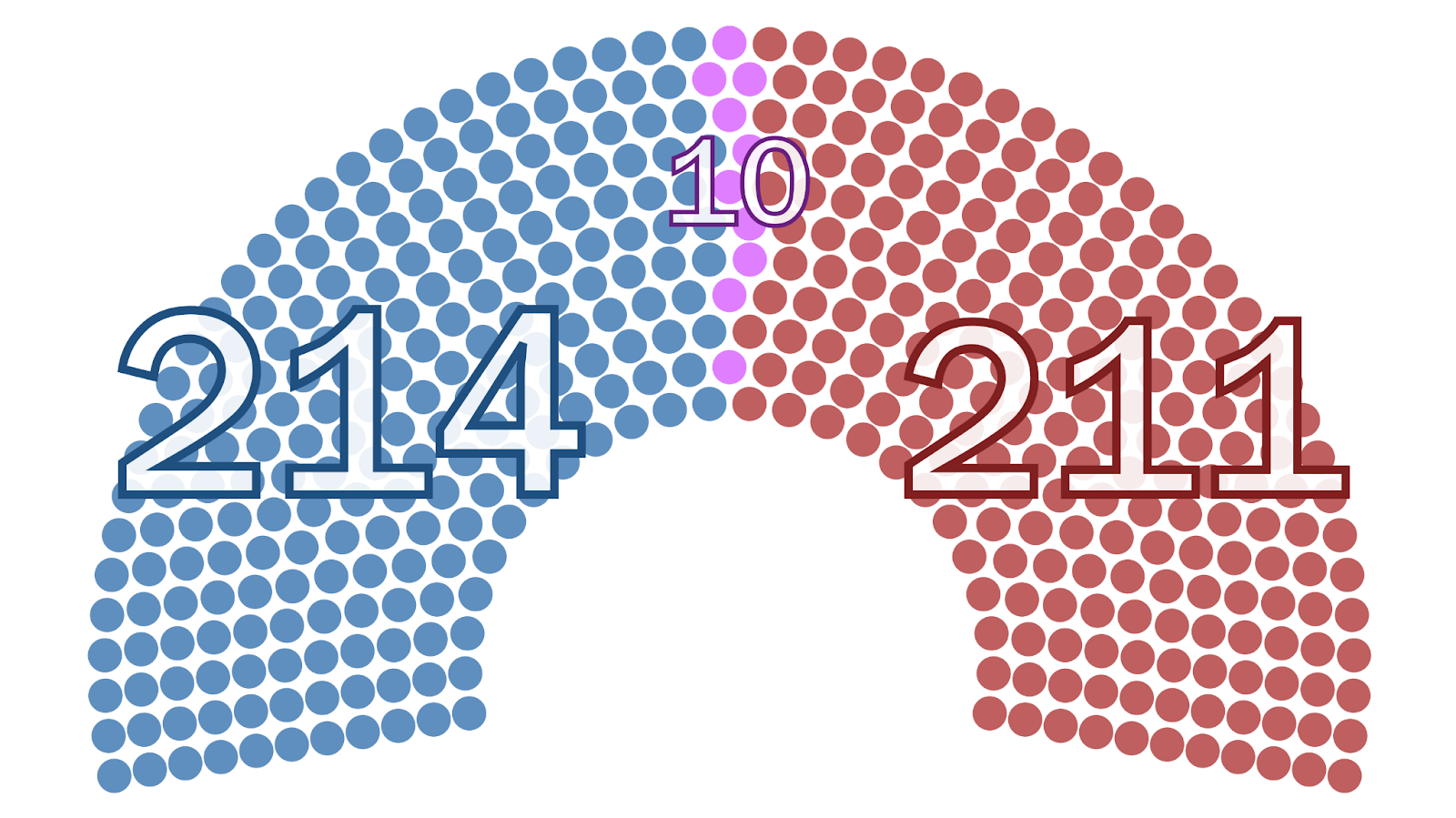
In our latest iteration of our House model, Democrats are ahead in 214 seats while the Republicans have the advantage in 211; 10 seats are rated as tossups. The most noticeable change, however, comes at the topline: Democrats now have a 58% chance of retaking the House. Our latest simulations place the median Democratic seat count at 219 seats, suggesting that any majority won by either side will once again be quite thin this time around. (You can view the full model and its outputs here, or if you prefer a raw spreadsheet, you can look here).
Much of this has to do with the polling surge the Democrats have seen over the last few weeks. While the polling downballot has not moved nearly as much, our model does still assume a certain level of influence a district’s projected presidential lean will have on the downballot results — for instance, we think that, all else being equal, a Democrat will simply have a better chance if Kamala Harris wins their district by 1, rather than being tied to an ailing Joe Biden losing their district by 3.
Under this lens, our modeling makes sense. House Democrats were previously paying a minor hit for Biden’s abysmal numbers; now, however, the situation has been somewhat reversed, with Harris taking a three-point lead in national polling and largely restoring the 2020 coalition Biden previously won with.

The individual seat changes also tell a story of improving Democratic fortunes. Of the fourteen, all but one have moved away from the Republicans; and even that seat, AZ-01, moved from tossup to leans Republican only because incumbent David Schweikert maintains a substantial lead over Amish Shah, his Democratic opponent. Shah has little cash on hand, but given that AZ-01 is a Biden-won seat, he could well rebound in the final stretch of the campaign.
Of the remaining thirteen seats, four are moving off the map from likely to safe Democratic. These are AZ-04, FL-23, GA-02, and NY-03. Of particular note is NY-03, which was won by Republican George Santos in 2022. After his expulsion, former representative Tom Suozzi regained the seat for the Democrats. Suozzi, a proven overperformer, is a comfortable favorite against fairly weak opposition.
Four more districts are moving from leans to likely Democratic. These are MD-06, NH-02, NY-04, and OH-13. One of these seats, NY-04, is projected to flip from Republican to Democratic control; here, Anthony D’Esposito was narrowly carried over the line in 2022 in this Biden +14 seat as a result of New York’s statewide red wave, but the fundamentals suggest that Democrat Laura Gillen will retake the seat for the Democrats.
Three tossups are moving into the Democratic column as well. In ME-02, blue dog Democrat Jared Golden is now favored in his reelection bid against Austin Theriault. Golden is a strong incumbent who has won thrice in this Trump-won seat. Importantly, Harris has also been exceeding expectations in polls of the presidential race conducted in the district.
The other two tossups, PA-07 and PA-08, are districts that Republicans put significant effort into winning in 2022. Ultimately, they came up short. Democrats Susan Wild and Matt Cartwright (who represents a Trump-won district) now have the advantage against their opponents.
Finally, in CA-45, Republican Michelle Steel seems increasingly vulnerable. This is the only district moving from Leans Republican to tossup. Democrat Derek Tran still trails Steel on the fundraising front, but the district fundamentals, coupled with an improving national political climate for Democrats, put him in striking distance. We still expect Steel to eke out a win, but we believe it will be closer than it would have been with Biden at the top of the ticket, especially given that Harris seems to do a lot better in polling with most non-white voters — though the local Vietnamese bloc vote can remain unpredictable.
This set of circumstances is rather unprecedented — we’ve never quite seen a situation in which the presidential nominee was outright replaced, let alone this close to the election. It is equally unusual to find a candidate whose favorables went from –14 to breakeven virtually overnight, but Kamala Harris has managed to do it, offsetting virtually all of the public image boost that Trump and the GOP were set to enjoy from the assassination attempt and the convention, respectively.
This obviously makes it even more difficult to model, especially downballot, where the evidence we have is directional at best. The only thing we feel confident in saying is that this is set to be a close election again, with coalitions that are broadly likely to resemble 2020’s. This is true at both the House and the Presidential level, where any victory for either side is likely to be extremely tight, and neither party is likely to enjoy a wave election this time around.
But at this juncture, you’d just barely rather be the Democrats, especially in the House (where their edge is probably clearest). Whether that lasts, of course, is anyone’s guess.

I’m a computer scientist who has an interest in machine learning, politics, and electoral data. I’m a cofounder and partner at Split Ticket and make many kinds of election models. I graduated from UC Berkeley and work as a software & AI engineer. You can contact me at lakshya@splitticket.org

My name is Harrison Lavelle and I am a co-founder and partner at Split Ticket. I write about a variety of electoral topics and handle our Datawrapper visuals.
Contact me at @HWLavelleMaps or harrison@splitticket.org

I make election maps! If you’re reading a Split Ticket article, then odds are you’ve seen one of them. I’m an engineering student at UCLA and electoral politics are a great way for me to exercise creativity away from schoolwork. I also run and love the outdoors!
You can contact me @politicsmaps on Twitter.

I am an analyst specializing in elections and demography, as well as a student studying political science, sociology, and data science at Vanderbilt University. I use election data to make maps and graphics. In my spare time, you can usually find me somewhere on the Chesapeake Bay. You can find me at @maxtmcc on Twitter.

I’m a political analyst here at Split Ticket, where I handle the coverage of our Senate races. I graduated from Yale in 2021 with a degree in Statistics and Data Science. I’m interested in finance, education, and electoral data – and make plenty of models and maps in my free time.