

Ticket-splitting has hit record lows in recent years. In 2024, the number of “crossover districts” in the House dropped to just sixteen — with thirteen of them electing a Democrat to Congress despite voting for Trump. Growing political polarization has made it extraordinarily difficult for down-ballot candidates to draw from dwindling cross-party support and win races in hostile political territory, especially in presidential cycles.
In the face of this trend, however, New England has remained a bastion of crossover voting. In 2024, down-ballot Democrats overperformed significantly in six of the region’s House races — a pattern that could well be repeated come 2026.
These congressional Democratic successes become even more impressive when you consider how New England’s voting behavior changed in 2024. The region shifted towards Trump despite its comparatively high shares of white, high-income, and highly educated voters — all demographics that Harris generally held up well with relative to Joe Biden.
All this begs the question: how did our six Democratic congressmen manage to run so far ahead of Harris? To answer that question, we have to look at what they all have in common.


One fact in particular stands out when looking at our six lawmakers. In today’s highly polarized political environment, all six have a comparatively strong record of moderation and bipartisanship.
Using DW-NOMINATE, a metric which gauges a lawmaker’s political positioning based on his ideology and voting history, we see that our New England overperformers are collectively close to the centrist wing of the Democratic caucus. In fact, the group’s average score is only –0.25 — putting them closer to Republican David Valadao (0.26) than to former Speaker Nancy Pelosi, who has a score of –0.78.
There’s also strong empirical support for the argument that these Democrats are more moderate than average, especially when you consider the districts which they represent. Massachusetts Democrat Stephen Lynch, for example, has faced criticism for past positions on abortion access and supported the Laken Riley Act earlier this year. Fellow New England Democrats Joe Courtney, Jared Golden, and Chris Pappas also voted for the bill.
But Lynch does not stand alone in his moderation. Pappas, who is running for New Hampshire’s open Senate seat in 2026, voted against decriminalizing marijuana in 2022. Similarly, Jared Golden, a Marine Corps veteran who once served as an aide for Senator Susan Collins, refused to endorse Harris in 2024 and even voiced support for President Trump’s tariffs.

The electoral strength of these six lawmakers sheds light on how candidate quality differentials could affect the Democratic Party’s odds of retaking the House and Senate in 2026. Maine Republican Susan Collins, for example, has a reputation as one the strongest incumbents in the nation. She won re-election in 2020 with a WAR score of R+14, making Maine the only state that cycle to support different parties for the Senate and the presidency.
More concretely, the 2024 results can tell us a lot about New England’s midterm dynamics. At the top of the ticket, Harris made gains with high-income and college-educated voters in suburban towns throughout the region. These enclaves are home to high-propensity voters, who tend to be more engaged in the political process and are usually more likely to participate in primary contests and midterm elections.
Trump, on the other hand, made big inroads with lower-income, non-college-educated voters across the board. He ran particularly well with urban Latinos, while also drawing significant support from ethnic whites. Both of these groups feature more low-propensity voters, who turn out at lower rates when their preferred presidential candidate isn’t on the ballot.

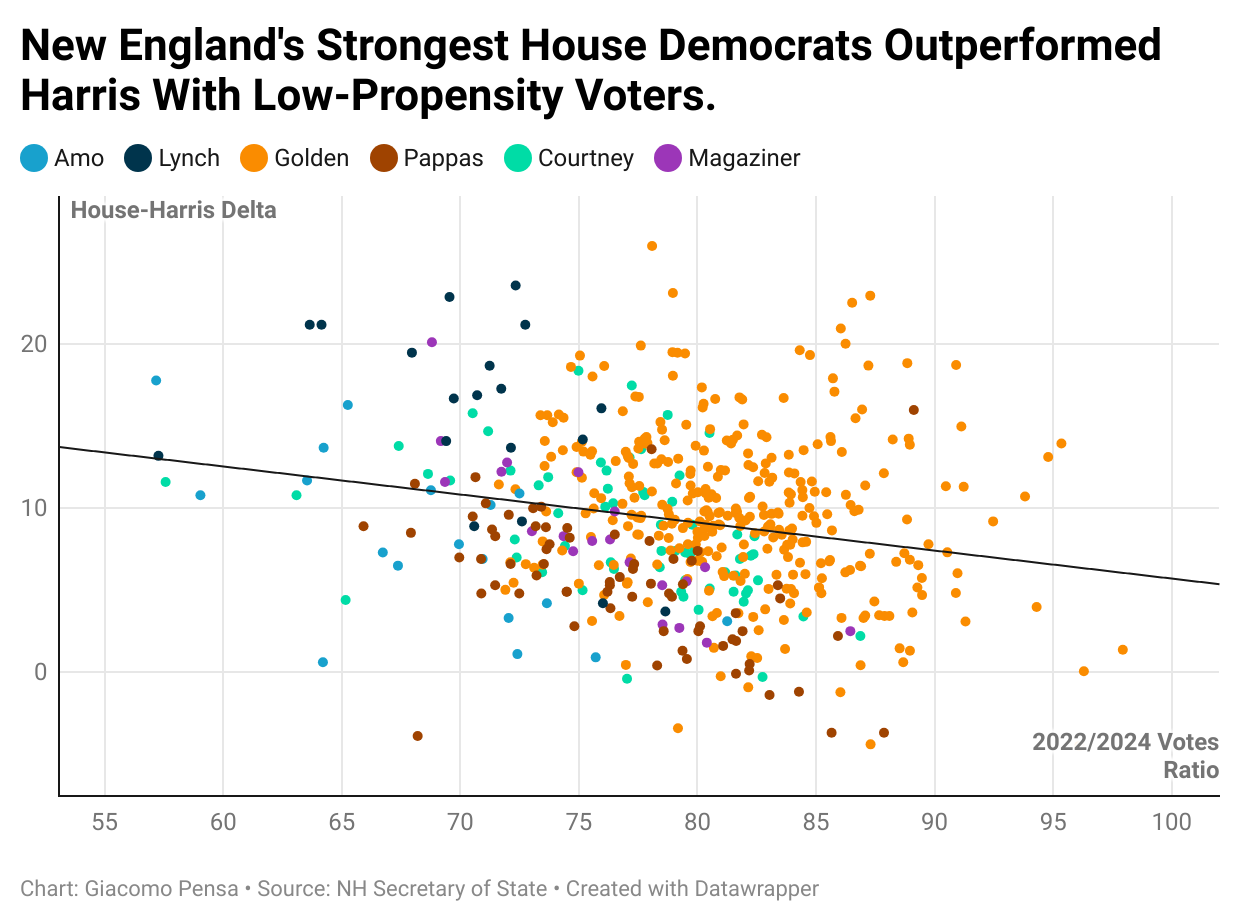
Yet our six down-ballot Democrats still outperformed Harris in these rightward-shifting regions, dominating with low-propensity voters.
In the highest-propensity municipalities, down-ballot Democrats overperformed by just 4.6%. Among the least engaged voters, however, that number skyrockets to 13.6%. Trump’s success with low-propensity voters made the difference: infrequent voters ended up breaking in the President’s favor according to the Catalist’s 2024 report.
But overperforming with low-propensity voters didn’t prevent our six Democratic lawmakers from faring well with high-propensity voters either. Even in the suburbs, which in recent years have experienced an important leftward shift, these Democrats still ran ahead of Harris, albeit by smaller margins. Out of over 600 municipalities across the six districts, Harris outperformed the congressional Democrat in only fourteen of them.
This stands in contrast to New England’s weakest congressional Democrats, who did only 1.3% better than Harris. Massachusetts Senator Elizabeth Warren, for instance, ran six points behind the top of the ticket. These candidates, closer to the progressive wing of the party, did best relative to Harris in low-propensity areas, while suffering with high-propensity voters.
As Democrats confront an internal struggle over the direction of the party heading into 2026, the data shows that centrists are better positioned to overperform in down-ballot races because they have greater appeal to less engaged voters and those who are willing to split their tickets.

I develop election forecast models and share data-based political analysis. You can find my insights on X at @giaki1310 and contact me at giaki1310@gmail.com

My name is Harrison Lavelle and I am a co-founder and partner at Split Ticket. I write about a variety of electoral topics and handle our Datawrapper visuals.
Contact me at @HWLavelleMaps or harrison@splitticket.org