
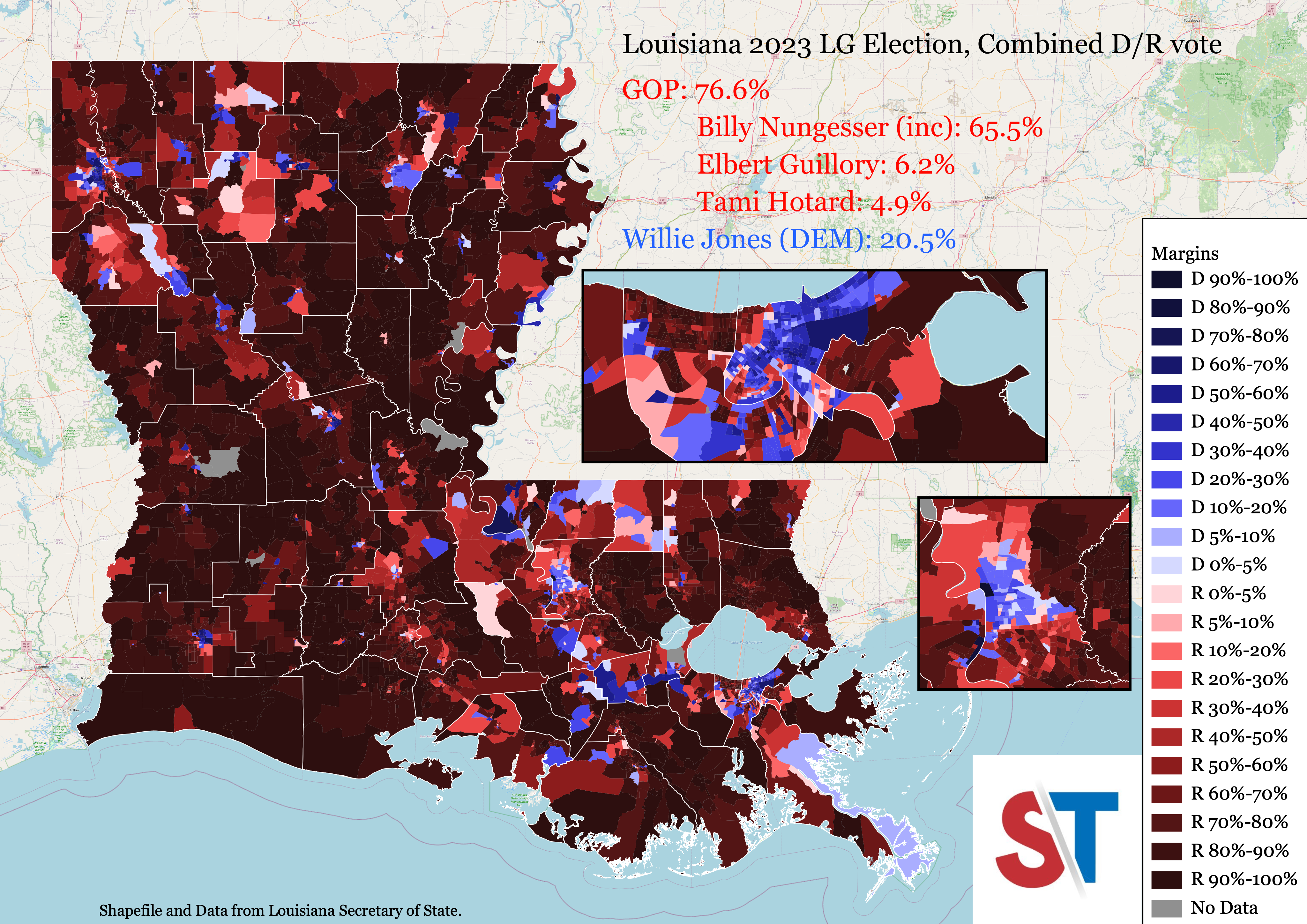
After the 2023 elections, Louisiana Republicans are arguably in their strongest position in history. The establishment of a firm supermajority eliminated the last vestiges of Democratic control from this formerly-blue “Solid South” state. As Democratic margins with southern white voters have steadily slipped cycle after cycle, margins with southern Black voters have usually held steady.
But in 2023, that changed. Republicans won a majority of the vote in most of the state’s parishes with large black populations, with Democrats seeing reduced margins in strongholds like New Orleans and Baton Rouge. The bleeding was even worse in rural areas, with 70% black East Carroll Parish giving only 50% of its votes to Democrats, after Biden won the parish by 27 just three years earlier. While the blame for these results was attributed to turnout, these results appeared to fit a continuing pattern of working-class minorities fleeing the Democratic Party.
Today, we examine the Black vote in those 2023 races for Governor and Lieutenant Governor to identify some key findings and illustrate what actually happened. The results, after being broken down, are far more interesting than a simple explanation of ideology-related “race-depolarization” as many electoral analysts would believe.
Split Ticket used the composite partisan data from the October jungle primaries to estimate the share of the Black vote at a parish level. The results are displayed below, for the gubernatorial election.
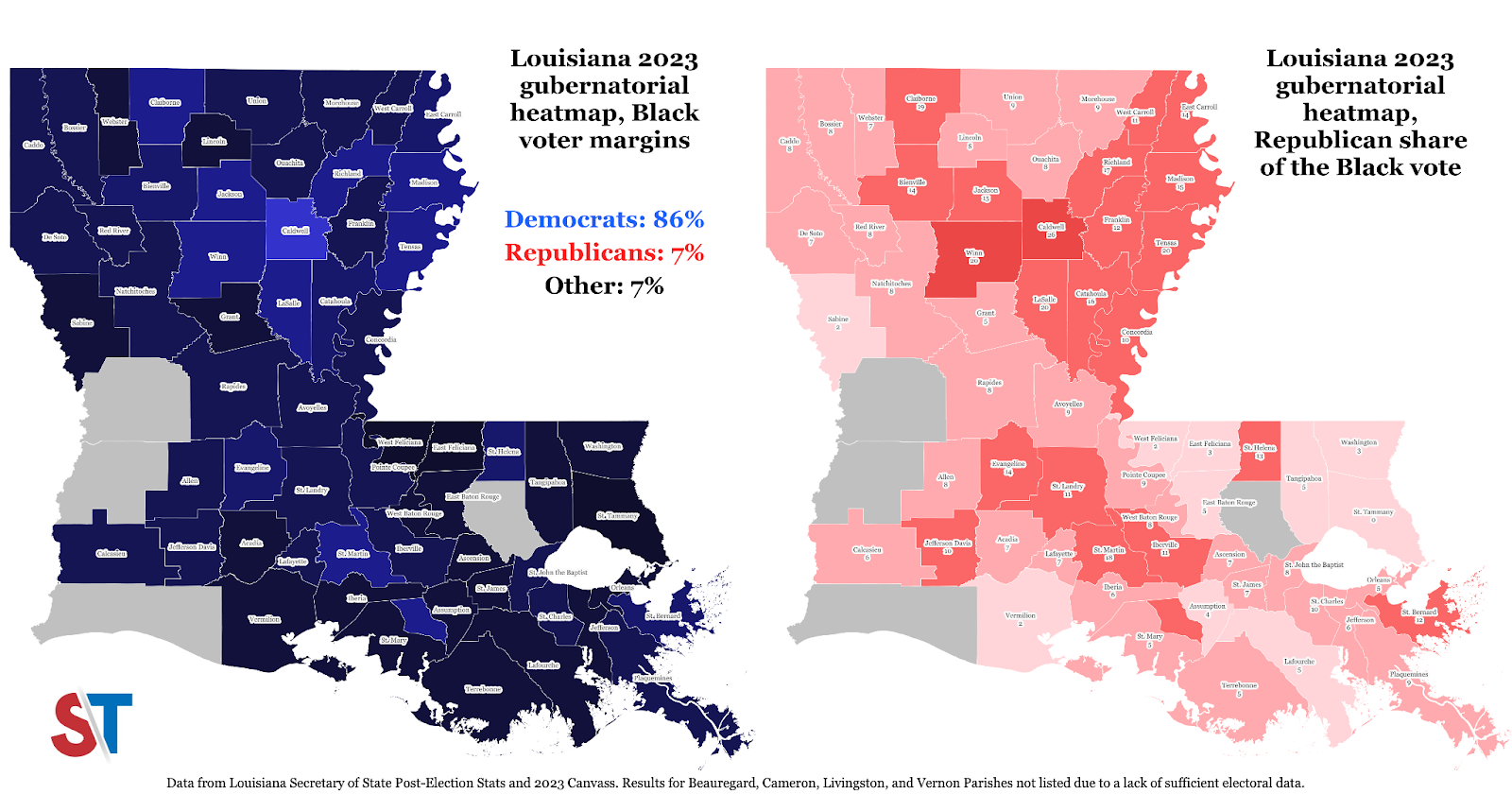
Republicans only received about 7% of the Black vote statewide. Given the blowout nature of the race, this is well within the expected vote share range, and falls far short of the “Black voter realignment” heralded by many actors in political discourse. What is more interesting, is showing where exactly Republicans’ support was stronger.
Interestingly, a cluster of parishes in Northeast Louisiana, has double-digit GOP support for Black voters, with Caldwell and Winn Parishes topping out at over 20%. These areas are highly rural and religious and among some of the most culturally conservative areas of the nation. Split Ticket has written about them in the context of State Sen. Katrina Jackson’s abortion-driven electoral overperformance.
Similarly, in rural Acadiana, one can observe double-digit Black GOP support. This shows that even across Louisiana, Black communities are not monolithically Democratic and there are varying degrees of conservatism.
As an aside, the results of this map confirm a prior article investigating a hypothetical black-majority district that would have turned Rep. Julia Letlow’s safe-red 5th district into a competitive race. The lion’s share of these “conservative Black” parishes are within her 5th district territory — but due to internal squabbles the Louisiana GOP decided to take out Republican Garret Graves in Baton Rouge instead, leaving him with virtually no chance of holding the seat. Had the map drawers instead targeted Letlow’s 5th district for a redraw, the higher Black GOP vote share perhaps could have aided Republican chances of keeping the seat.
But if the gubernatorial race was mostly predictable, the Lieutenant Governor’s race was anything but. Incumbent Billy Nungesser easily demolished his opponents, and Republicans won a combined 77% of the vote. Given how racially polarized Louisiana politics normally is, this means that Nungesser achieved the unthinkable: siphoning off a huge chunk of Black voters. The results confirm this hypothesis.
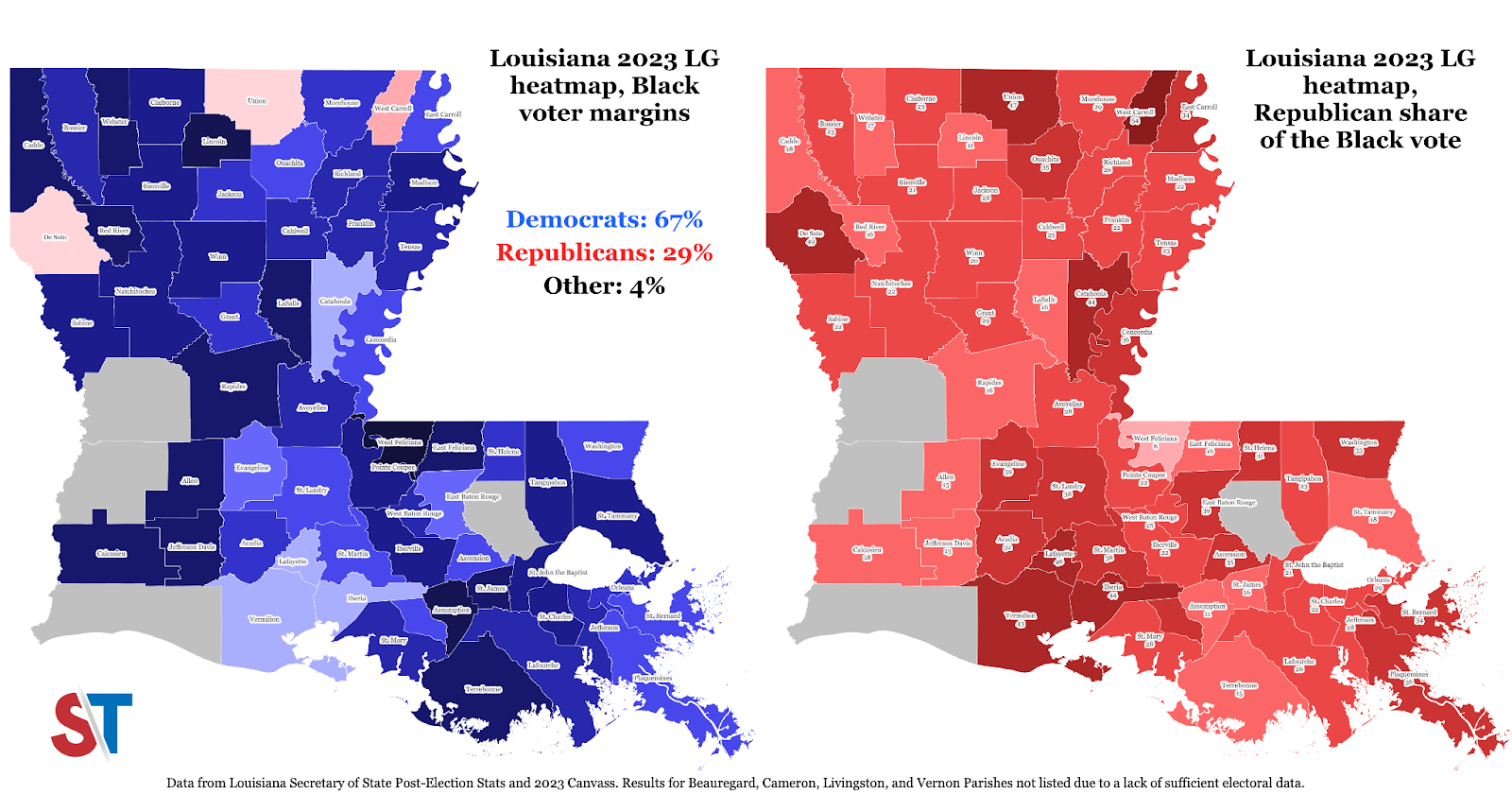
As we can see, Nungesser won a whopping 29% of the Black vote, which is among the highest numbers for the GOP with this demographic post-Reconstruction. Unlike Landry, this improvement was pronounced everywhere, including in urban areas, where he received nearly 30% of the Black vote in New Orleans and nearly 40% in Baton Rouge. In what is probably the first time since the 19th century, Republicans actually won the Black vote in three rural parishes — DeSoto, Union, and West Carroll. These are conservative areas, but still, given how persistent Democratic margins with Black voters are, these results are stunning.
The explanation for this discrepancy between expectations and reality is twofold. First, Black turnout was significantly down in 2023. This naturally lowers the Democratic floor, as Black voters are the only real base for Louisiana Democrats, and outside of a few neighborhoods of New Orleans, there is no “critical mass” of liberal whites. This phenomenon is similar to how Florida Governor Ron DeSantis’s large margins in his 2022 re-election were higher than they likely would have been, had a more representative electorate shown up to vote.
Second, and more importantly, Republicans made an effort to persuade Black voters to their side. Gubernatorial candidate Jeff Landry, who is generally regarded as hard-right, ran aggressively on crime. Against an anemic Democratic organization, this messaging definitely broke through to some degree. And with Nungesser and the Lieutenant Governor’s office, his relatively nonpartisan nature has earned him widespread credibility that undoubtedly helped him win between a huge chunk of Black votes.
Taken all together, the result shown by the Louisiana elections is a story of candidate quality and persuasion rather than a mere exercise in demographic trends such as “race depolarization”. Specifically, Black voters are not a monolith. Even within Louisiana, there is widespread variation among different areas. But, if a candidate is willing to work for votes, they are very gettable. The 2024 election is now on the horizon and will likely be decided by a close margin. Perhaps the lessons of this article are something that campaign politicos would be good to heed — every vote matters.

I’m a political analyst here at Split Ticket, where I handle the coverage of our Senate races. I graduated from Yale in 2021 with a degree in Statistics and Data Science. I’m interested in finance, education, and electoral data – and make plenty of models and maps in my free time.