
Analyzing the Jewish Vote is a challenging task. The U.S. Census does not track either Jewish religion or ethnicity, and who “counts” as Jewish is itself a controversial question. For our purposes, we will limit our analysis to 7.5–7.6 million Americans, including 5.8-6.1 million eligible voters (2.4% of the electorate), who are either Jews by religion (JBR) or Jews of no religion (JNR). With that being said, Jewish voters are not a monolith and we only hope to give an overview of Jewish opinion and voting patterns.
Traditionally, Jewish-Americans are a core constituency of the Democratic Party. Supermajorities supported George McGovern in 1972 and Walter Mondale in 1984, and an average of exit polls from Democratic, Republican, and nonpartisan sources suggest that Jewish voters backed Biden by 42% in 2020. Our average of exit polling in 2024 finds a 36% margin in favor of Harris — suggesting a swing of R+6% between 2020 and 2024.
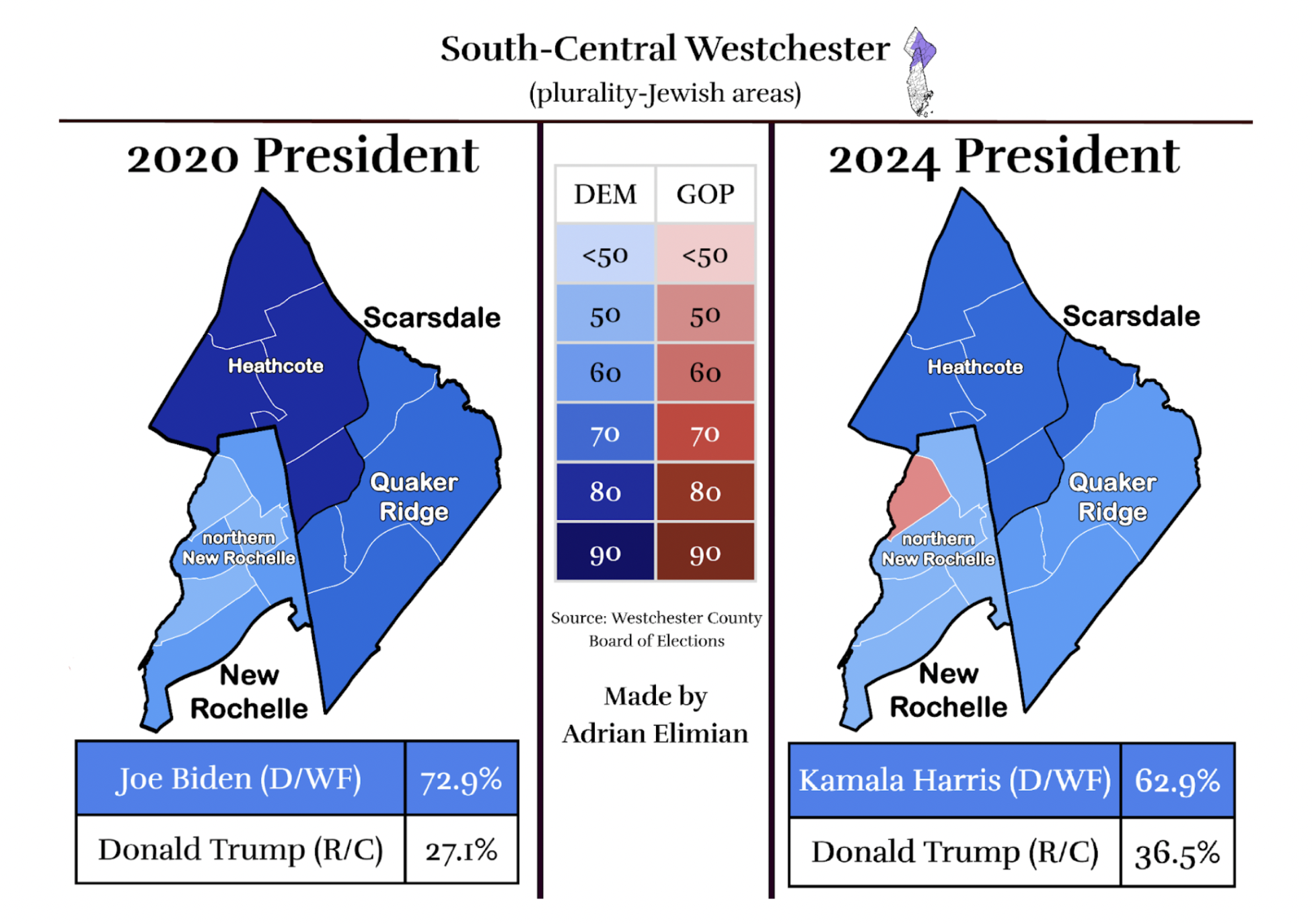
In addition, while we advise against treating data from more Jewish geographies as representative of Jewish-Americans as a whole, we find that places like Squirrel Hill, PA (~50% Jewish), Teaneck, NJ (~40% Jewish), and Scarsdale, NY (~30% Jewish) swung by R+3%, R+8%, and R+12%, respectively. These results, when taken together with exit polls, suggest an actual swing right that is between 5 and 10 percentage points.

Still, Jewish voters remain overwhelmingly Democratic, partially due to educational attainment and socially liberal beliefs. Six in ten Jewish adults have a college degree and seven in ten live in states that Harris won in 2024. But demographics don’t necessarily explain the liberal nature of this group — Jewish support for Democrats long predates educational polarization, and so these demographic characteristics, while important in this political environment, provide an insufficient explanation for Jewish-American voting patterns in general. We find that this is better explained by other factors, like ideology.
Jewish Opinion Polling
Before we dive into a breakdown of Jewish-American opinions on key issues, please note that we will not harp on distinctions between Jewish denominations or specific immigrant background. Our central contention echoes previous research: American Jews are socially liberal, economically moderate, and often hold multiple contradictory opinions about Israel (see: supplement).
Firstly, most of the Jewish voting pattern can be explained by liberal social views, including on LGBTQ+ and abortion rights. A 1984 poll, taken at the height of HIV-AIDS-related “gay panic,” showed that 87% of Jews thought “homosexuals should have the same rights as other people,” and a 2004 study found that 85% of Jews supported gay marriage or civil unions. On abortion, the Manhattan Institute found that 80% of Jews and 50% of Jewish Republicans identify as pro-choice, with the Jewish Electoral Institute showing that 88% think that abortion should be legal in all or most cases. 2024 election exit polling from J-Street found that 26% of Jews ranked “abortion” as their most important issue (compared to 14% of the general electorate) — making it second only to “the future of democracy,” which was ranked as the most important issue for at 53% of Jewish voters (versus 34% for the general electorate).
Economically, Jewish opinion is moderate. Although Jews are more likely to approve of “government services and spending” than non-Jews (52% vs. 36%), there is no difference with non-Jews when asked whether the state should “reduce income inequality” (41% vs. 43%) or “favor government health insurance” (45% vs. 42%). In 2022, polling found that 32% of Jews blamed corporate greed for inflation while 31% blamed supply chains and 23% blamed government spending — reflecting the general electorate rather than anything uniquely Jewish, after accounting for strong affiliation with the Democratic Party.
Finally, on Israel, the Manhattan Institute found that 92% of Jews identify as pro-Israel, while Pew shows that 89% and 54% hold favorable views of “the Israeli people” and “the Israeli government,” respectively. Israeli Prime Minister Benjamin Netanyahu is unpopular, with J-Street placing his net approval rating at -31%. J-Street also finds majority support for sanctioning far-right members of the Israeli cabinet (66%) and halting offensive weapons shipments to Israel (62%).
Jewish Denominations
There are three major denominations in American Judaism comprising 63% of the population, with the remainder being “Just Jewish.” The major sects are Reform (37%), Conservative (17%), and Orthodox (9%), with Orthodox Jews further subdivided into Modern Orthodox (40%) and Haredi (60%) groups.
With respect to the latter, Haredi neighborhoods are essentially homogeneous in any given contest, but also have high levels of ticket-splitting. Only 10% of Haredi voters reported straight ticket voting in 2024 and 89% said that “issues specific to the Jewish community” are important to how they vote in local races. This is seen in Kiryas Joel — a Satmar Haredi community in the Catskills — where internally popular figures like Andrew Cuomo and Donald Trump received near-universal support while unpopular figures like Kathy Hochul only won by a small margin despite receiving endorsements from local religious leaders.

Modern Orthodox voters, by contrast, are more of a swing demographic. But data from the mixed Haredi-Modern Orthodox enclave of Lakewood, NJ suggests a large swing towards Republicans in 2024, shifting right 16 points versus 2020. This is also seen in Nishma Research polling, which found a swing of R+12 among Modern Orthodox voters between September 2023 and 2024.
A plurality of American Jews are either Conservative or Reform, although the two have been “converging” for decades in some respects. The most reliable Jewish voters fall into these categories, including 69% of over-65-year-olds. Despite Conservative Judaism’s numerical decline, Reform Judaism continues to grow — from 35% in 2013 to 37% in 2020. This is primarily because American Reform recognizes some patrilineal Jews and is more inclusive of Jews of no religion, 17% of whom identify as Reform.
Pew found that 75% of Conservative Jews and 91% of Reform Jews identified as either liberal or moderate in 2020, with the groups being 70% and 80% Democratic, respectively. Exit polling from the Jewish Electorate Institute found that Reform Jews supported Harris over Trump by a margin of D+69% while Conservative Jews did the same by D+53%, but the swing versus 2020 is unclear.
Data from Reform and Conservative concentrations in the New York City suburbs help to fill in the gaps. On the North Shore of Long Island (27% Jewish, 56% of Jews being Reform or Conservative), the Hamlet of Port Washington swung by R+9% while the Village of Roslyn swung by R+18% between 2020 and 2024. Meanwhile, in South-Central Westchester, plurality-Jewish areas that are overwhelmingly Reform and Conservative like Davis (New Rochelle), Quaker Ridge (Scarsdale), and Heathcote (Scarsdale) swung by R+18%, R+19%, and R+18% respectively, further suggesting that a rightward swing took place.

On one hand, these areas might not be entirely representative of either Reform or Conservative Jewish voters, and they still voted for both Biden and Harris by large margins. On the other hand, it is notable that despite Harris’ performance among college-educated White voters versus Biden, she still lost ground in places like Scarsdale and northern New Rochelle — where most Jews are college-educated and considered White.
The New Jewish-Americans
Jewish-American life has significantly changed in the past few decades, primarily due to immigration and intermarriage. Between 700,000 and 800,000 Jewish immigrants have arrived since 1970, primarily from the former USSR, Israel, Latin America, and Iran. The interfaith marriage rate also rose from 32% in 1970 to 61% in 2020, meaning that newer generations of Jews are more ethnically and racially diverse. As a result, Jewish-American identity is increasingly heterogeneous, and this appears to be reflected in survey data and voting patterns.
Take, for example, the 2021 Brandeis/SSRI study of Jewish Los Angeles, which polled ideological self-identification for three Jewish immigrant groups — Russian Speaking Jews (RSJs), Hispanic Jews, and Persian Jews — as well as for LGBTQ+ Jews and Jewish People of Color (JPoC). All three immigrant communities had larger percentages reporting “conservative” or “very conservative” beliefs than pre-existing communities, but Hispanic Jews were also more likely to report “very liberal” beliefs than other groups. Russophone and Persian American Jews seem to be particularly right-leaning compared to pre-existing communities, and studies on Israeli Americans (who number around 200,000) suggest their politics are both more liberal than Israelis in Israel and more conservative than the median Jewish-American voter.
There also exist around ~350,000 Jews in other smaller immigrant communities of interest, including from Central Asia, Ethiopia, Syria, South Africa, and North Africa. In any case, there are political differences between different Jewish immigrant groups and between these groups and pre-existing communities. These are unique sets of voters with different experiences and preferences.
The same study also polled JPoC and LGBTQ+ Jews, which represent 6% and 7% of LA’s Jewish community, respectively. Both groups are considerably more likely to report “liberal” or “very liberal” politics than Jewish adults as a whole, with very few being conservative or very conservative. This exemplifies how the increasing diversity of the Jewish community has led to new sets of Jewish voters whose political beliefs are informed by multiple overlapping identities.

Places to Watch
Despite being only a small portion of U.S. adults, Jewish voters are likely to play an outsized role in some upcoming elections — namely, the New York City mayoral and New Jersey gubernatorial races. In addition, several key congressional districts have large Jewish constituencies, and Jewish voters may be critical in NJ-05 and NJ-11, where special elections could arise if either Reps. Josh Gottheimer or Mikie Sherrill are successful in their gubernatorial campaigns.

In the medium term, Jewish voters will continue to be heavily represented in special elections and Democratic primaries. This is due to Jewish voters being overwhelmingly registered Democrats and benefiting from a 20-point turnout differential compared to non-Jews — which is caused by higher levels of educational attainment and income rather than anything uniquely Jewish. We saw this in our reporting on the NY-16 Democratic primary, where Jewish-Americans potentially made up anywhere between 15-25% of the electorate, despite only constituting 9.5% of the population.
More dangerously for Democrats are the long term implications of a change in Jewish voting habits in combination with other trends, particularly among working class Hispanic and Asian Americans. The 2024 presidential election in New Jersey is particularly illustrative, with the state shifting from D+16% to D+6% between 2020 and 2024. While the 5–10 point rightward swing among Jewish voters is clearly insufficient to explain what happened in New Jersey, it could be a key factor: in places like Wisconsin, Democratic gains in educated suburbs have mitigated continued bleeding in rural areas, but in places like New Jersey and New York, a swing right among college-educated Jews may have doomed the party’s attempt to mitigate the strong GOP gains of 2024.
Jewish voters remain a meaningful slice of the electorate, and their rightward swing in 2024, while relatively mild on paper, opposes what might otherwise be expected from the lens of education attainment motivating voting. Even if small in number, this demographic often plays a key role in primaries, low turnout races, and in elections otherwise defined by educational polarization.

Jacob Rosewater is a senior at Cornell University with a major in Urban and Regional Planning and a
minor in Animal Science. He specializes in regional housing
and land use policy, the institutional
development of suburban municipalities in New York State, and quantitative geography in the field of American Jewish studies. Feel free to reach out via email at jlrosewater@gmail.com with any questions or comments.

I’m a student studying political science. I’m interested in geography, history, mapping, and politics — American and international — which I have experience research and writing about. I’ve focused on political party development, corruption, and connections between demographics and voting intentions. You can find me at @adriaeln on Twitter or adrianelimian@gmail.com by email.